
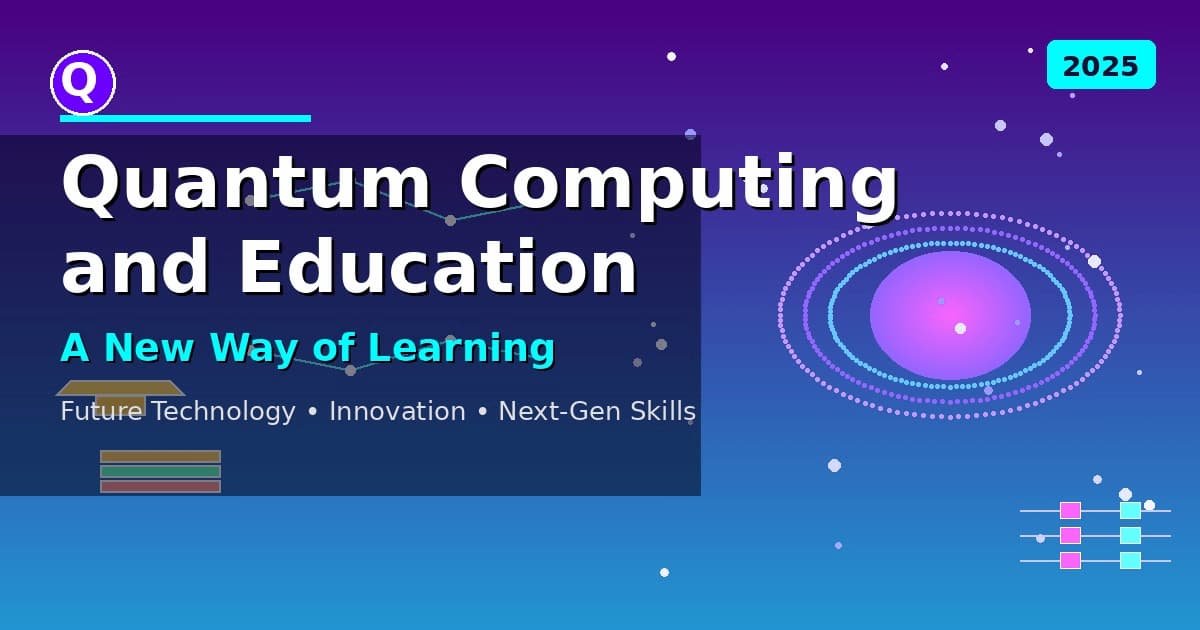
Think back to your school or college days. Most subjects were taught with textbooks, whiteboards, and later, computers. Those tools worked well—but they were built for a world where problems could be simplified, slowed down, and solved step by step.
Today’s challenges don’t behave that way. Climate modeling, drug discovery, cryptography, and complex systems in economics all operate at a faster pace and interact in intricate ways that are challenging to dissect. Education is starting to feel that strain. And the present is where quantum computing quietly enters the conversation—not as a distant science-fiction idea, but as a technology that could reshape how we learn.
This article explores how quantum computing could change education, in clear and practical terms, even if you have never studied physics or advanced computing before.
Why Traditional Computing Shapes the Way We Learn
Every digital tool used in education today—from learning apps to simulations—runs on classical computers. These machines process information using bits that are either 0 or 1. This binary structure has influenced how subjects are taught:
- Problems are broken into linear steps
- Simulations are simplified to fit computing limits
- Learning often focuses on memorization over exploration
While this approach works for many fields, it struggles when systems become too complex or interconnected. Quantum computing challenges this limitation.
A Simple Way to Understand Quantum Computing
Quantum computing is not just a faster version of today’s computers. It works differently at a fundamental level.
Instead of bits, quantum computers use qubits, which can represent multiple states at the same time. Without diving into physics, the key idea is this:
Quantum computers can explore many possible solutions simultaneously, rather than one at a time.
This creates opportunities for education that traditional computing fails to provide.
Why Quantum Computing Matters for Learning
Education is not just about answers—it’s about understanding systems, testing ideas, and learning from exploration. Quantum computing aligns well with these goals.
Here’s why it matters:
- It allows deeper simulations of real-world systems
- It encourages interdisciplinary thinking
- It pushes learning beyond memorization into reasoning
As this technology matures, education may shift from static lessons to dynamic, discovery-based experiences.
How Quantum Computing Could Transform Science Education
More Realistic Simulations
In subjects like chemistry, physics, and biology, students often rely on simplified models. Quantum computing can simulate molecular interactions more accurately, helping learners:
- Visualize chemical reactions
- Understand protein folding
- Explore material behavior at atomic levels
Instead of memorizing formulas, students could experiment with systems virtually.
Changing the Way Mathematics Is Taught
Quantum computing introduces new ways of thinking about math—especially probability, vectors, and linear algebra.
Rather than treating math as abstract symbols, students could:
- See mathematical concepts in action
- Explore how probabilities interact
- Learn why certain problems are difficult for classical computers
This could make advanced mathematics feel more intuitive and relevant.
A New Approach to Computer Science Education
Computer science education today is built around classical logic. Quantum computing introduces a new paradigm that encourages:
- Thinking in probabilities rather than absolutes
- Designing algorithms that explore multiple paths
- Understanding limits of computation itself
As quantum concepts enter classrooms, students may learn how computers think, not just how to code them.
Interdisciplinary Learning Becomes the Norm
Quantum computing does not belong to one subject. It naturally connects:
- Physics
- Computer science
- Mathematics
- Engineering
- Philosophy of science
Education systems could move away from isolated subjects toward integrated learning, where students solve problems that require knowledge from multiple fields.
This mirrors how real-world research actually works.
Making Abstract Concepts More Concrete
Teaching ideas that are difficult to see or touch presents one of the biggest challenges in education. Quantum computing tools can help by:
- Visualizing invisible processes
- Turning equations into interactive models
- Allowing students to test “what if” scenarios
Learning becomes more experiential, reducing reliance on rote memorization.
What This Means for Teachers and Educators
Quantum computing will not replace teachers. Instead, it may change their role.
Educators could become:
- Guides who help students ask better questions
- Facilitators of exploration rather than lecturers
- Interpreters who connect abstract results to real-world meaning
Teaching may focus more on thinking skills and less on repeating information.
Practical Challenges to Address First
It’s important to stay realistic. Quantum computing in education faces real hurdles:
- Limited access to quantum hardware
- Need for teacher training
- Risk of widening the digital divide
- Complexity of the underlying science
Early adoption will likely happen through cloud-based tools and simplified educational platforms rather than direct classroom hardware.
Why Early Exposure Matters
Even if students never use a quantum computer directly, learning about quantum thinking has value.
It helps learners:
- Understand uncertainty and probability
- Think beyond linear cause-and-effect
- Prepare for future scientific and technological shifts
This kind of mental flexibility is useful far beyond quantum computing itself.
Long-Term Implications for Education Systems
As quantum computing becomes more accessible, education systems may need to rethink:
- Curriculum design
- Assessment methods
- Skill priorities
Instead of testing how well students recall facts, education may emphasize:
- Problem framing
- Model building
- Critical interpretation of results
These are skills that remain valuable even as technology evolves.
A Balanced Way to Look at the Future
Quantum computing will not suddenly rewrite education overnight. Its impact will be gradual, uneven, and shaped by policy, access, and thoughtful implementation.
But its deeper influence may be philosophical rather than technical. It challenges the idea that learning must follow fixed paths. It encourages curiosity, exploration, and comfort with uncertainty.
Closing Thoughts: Education Beyond Answers
At its core, education is about helping people understand the world—not just pass exams. Quantum computing offers tools that align with that purpose by allowing learners to explore complexity instead of avoiding it.
As this technology continues to develop, its greatest contribution to education may not be speed or power, but a shift in mindset: from learning answers to learning how to think.
That change, if guided carefully, could be one of the most meaningful educational transformations of the coming decades.
Related Article :

One thought on “Quantum Computing and Education: A New Way of Learning”