
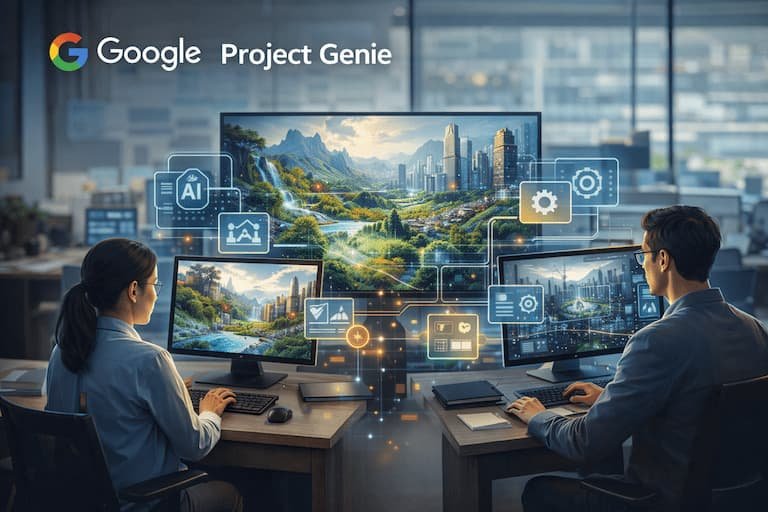
When You Wish Software Could Understand the World the Way You Do
Think about the last time you tried to explain a simple idea to a computer. Maybe you wanted a game to react more realistically, a simulation to feel less scripted, or an educational tool to adapt naturally as you explored it. Often, the experience felt limited—predefined rules, repeated patterns, and very little true understanding of how the world actually works.
This gap between human intuition and machine behavior is something researchers have been trying to close for years. Recently, Google introduced a research project that takes a meaningful step in that direction. It’s called Project Genie, and it focuses on helping AI systems learn how environments behave—not by memorizing rules, but by observing and interacting.
This article explains Project Genie in a clear, beginner-friendly way, even if you’ve never studied artificial intelligence before.
Why Teaching AI About the World Is So Hard
Most software systems operate on instructions written in advance. If this happens, do that. This works well for predictable tasks but struggles when environments are complex or constantly changing.
Humans don’t learn this way. We learn by:
- Watching how things behave
- Trying actions and seeing results
- Adjusting our understanding over time
For AI to truly assist in areas like gaming, robotics, education, or simulation, it needs a similar learning ability. This is the problem Project Genie is designed to explore.
What Google’s Project Genie Is Trying to Achieve
Project Genie is a research effort focused on helping AI systems build internal models of environments. In simple terms, it teaches AI to understand how a digital world works by interacting with it, rather than relying on pre-written rules.
Instead of telling an AI:
- “This button always does X”
The AI learns:
- “When I press this, the environment usually changes in this way”
This may sound subtle, but it represents a major shift in how intelligent systems can be designed.
A Simple Way to Think About Project Genie
Imagine giving an AI access to short video clips of someone playing a video game. The AI isn’t told the rules of the game. It just watches what happens when actions are taken.
Over time, the AI begins to:
- Predict what will happen next
- Understand cause and effect
- Simulate possible future states
Project Genie explores how far this idea can go using modern machine learning techniques.
Why World Models Matter in Artificial Intelligence
A world model is an internal representation of how an environment behaves. Humans use world models all the time without realizing it.
For example:
- You know a glass will fall if pushed off a table
- You expect a door to open when turned correctly
- You predict traffic movement while driving
Project Genie aims to give AI systems a similar predictive understanding—within digital environments.
How Project Genie Works (Beginner-Friendly Explanation)
At a high level, Project Genie involves three main ideas:
1. Learning From Observation
The AI studies visual data (such as gameplay footage) to identify patterns.
2. Learning From Interaction
Instead of passively watching, the AI explores environments by taking actions and seeing outcomes.
3. Generating Simulated Worlds
Once trained, the AI can generate new but consistent environments that follow the same underlying logic.
This combination allows AI to act less like a script-following machine and more like a learner.
Why Google Is Researching This Now
Several trends make Project Genie especially relevant today:
- AI models are now powerful enough to process complex visual data
- Computing resources allow large-scale experimentation
- Demand for more adaptive AI systems is growing
- Games, simulations, and education need richer interactivity
Google’s long-term AI research focuses on foundational capabilities, not just short-term products. Project Genie fits that philosophy.
Real-World Areas Where This Research Could Matter
Although Project Genie is a research project, its ideas have broad implications.
Gaming and Virtual Worlds
Games could become more dynamic, with environments that respond intelligently rather than following fixed scripts.
Education and Learning Tools
Simulated environments could adapt to how students explore and learn, creating more engaging educational experiences.
Robotics and Simulation
Before deploying robots in the real world, training them in accurate simulated environments is critical. Better world models improve safety and learning speed.
AI Research and Reasoning
Understanding environments helps AI plan, reason, and make decisions more reliably.
What Project Genie Is Not
It’s important to keep expectations realistic.
Project Genie is:
- Not a consumer product
- Not a finished AI assistant
- Not replacing human creativity or control
It is a research step, designed to explore how AI can better understand and predict environments.
Why This Matters for the Future of AI
Many current AI systems are excellent at producing text, images, or answers—but struggle with deeper reasoning about consequences.
World-model research like Project Genie helps AI:
- Anticipate outcomes
- Learn from experience
- Adapt to new situations
These abilities are essential if AI is to become more helpful, reliable, and safe in complex tasks.
Practical Takeaways for Beginners
If you’re new to AI, here’s what Project Genie really represents:
- AI is moving from memorization to understanding
- Learning through interaction is becoming central
- Simulations are key to safer, smarter AI development
You don’t need to understand algorithms to appreciate the direction this research is heading.
Ethical and Responsible Considerations
As AI systems become better at simulating environments, responsibility becomes even more important. Google’s AI research generally emphasizes:
- Controlled experimentation
- Transparency in research findings
- Gradual deployment rather than sudden release
Project Genie is part of this careful, research-first approach.
A Broader Emerging Trend in Technology
Project Genie reflects a wider shift in AI research:
teaching machines how the world works, not just how to respond.
This trend is visible across:
- Simulation-based learning
- Reinforcement learning research
- Interactive AI systems
It suggests a future where AI tools feel more intuitive, predictable, and aligned with human expectations.
Looking Ahead With a Grounded Perspective
Google’s Project Genie is not about flashy features or instant applications. It’s about building the foundations for AI systems that can understand environments in a more human-like way.
For readers new to artificial intelligence, this project is a reminder that real progress often happens quietly—through research that focuses on fundamentals rather than headlines.
As AI continues to evolve, efforts like Project Genie help ensure that future systems are not just powerful, but also thoughtful, adaptable, and genuinely useful.
Related Article :

2 thoughts on “Google Project Genie Explained: How AI Learns Virtual Worlds”