
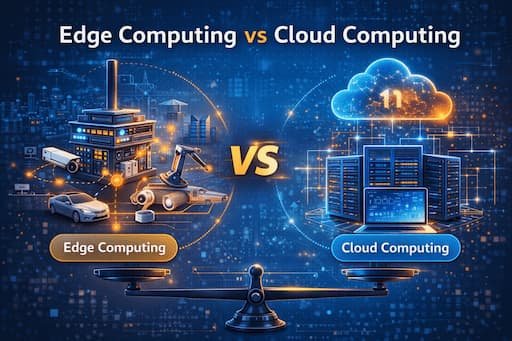
With the growth of the internet, smart devices, and data-driven applications, edge computing vs cloud computing has become a crucial technology. Although both deal with data processing, they work in different ways.
This article explains the difference between edge computing and cloud computing in simple language, using straightforward examples that students can quickly understand.
What Is Cloud Computing?
Cloud computing means storing and processing data on remote servers that are available over the internet. Instead of using your computer or local server, you use powerful data centers managed by cloud service providers.
Simple example:
When you store photos on Google Drive or watch videos on a streaming platform, cloud computing is working in the background.
Key features of cloud computing:
- Data is processed in centralized data centers
- Requires a stable internet connection
- Easy to scale up or down
- Widely used by businesses and individuals
What Is Edge Computing?
Edge computing means processing data closer to where it is generated, instead of sending it to a distant cloud server. The computation happens at the “edge” of the network, such as on devices, sensors, or nearby servers.
Simple example:
A smart security camera uses edge computing by analyzing video footage locally instead of sending all data to the cloud.
Key features of edge computing:
- Data processing happens near the device
- Faster response time
- Reduces internet usage
- Useful for real-time applications
Main Differences Between Edge Computing and Cloud Computing
| Feature | Cloud Computing | Edge Computing |
|---|---|---|
| Data processing | Centralized servers | Near the data source |
| Internet dependency | High | Low |
| Speed (latency) | Slower for real-time tasks | Very fast |
| Data transfer | Large data sent to cloud | Minimal data transfer |
| Best for | Storage, analytics | Real-time decisions |
Why Edge Computing Is Needed Along with Cloud Computing
Cloud computing is powerful, but it may not be swift enough for applications that need instant responses.
Edge computing helps by:
- Reducing delay (latency)
- Improving performance for real-time systems
- Saving bandwidth
- Supporting devices with limited connectivity
In many cases, edge and cloud computing work together, not as competitors.
Use Cases of Cloud Computing
Cloud computing is widely used in many areas.
- Data storage and backup
- Web hosting
- Online education platforms
- Business applications
- Big data analytics
It is ideal for applications that do not require immediate responses.
Use Cases of Edge Computing
Edge computing is best for real-time and location-based applications.
- Internet of Things (IoT) devices
- Self-driving vehicles
- Smart factories
- Healthcare monitoring systems
- Smart cities
Advantages and Limitations
Cloud Computing—Advantages
- Easy access from anywhere
- Cost-effective for storage
- High computing power
Cloud Computing – Limitations
- Internet dependency
- Higher latency for real-time tasks
Edge-based Computing—Advantages
- Low latency
- Faster processing
- Works even with limited connectivity
Edge Computing – Limitations
- Limited storage
- Higher setup cost
- Less centralized control
Edge-Based Computing vs. Cloud Computing: Which Is Better?
There is no single “best” option. The choice depends on the application.
- Use cloud computing for data storage, analysis, and large-scale processing
- Use edge computing for real-time, time-sensitive tasks
Modern systems often combine both technologies for better performance.
Conclusion
Edge computing vs cloud computing is not about choosing one over the other. Both technologies play important roles in modern computing.
Related Articles:
