
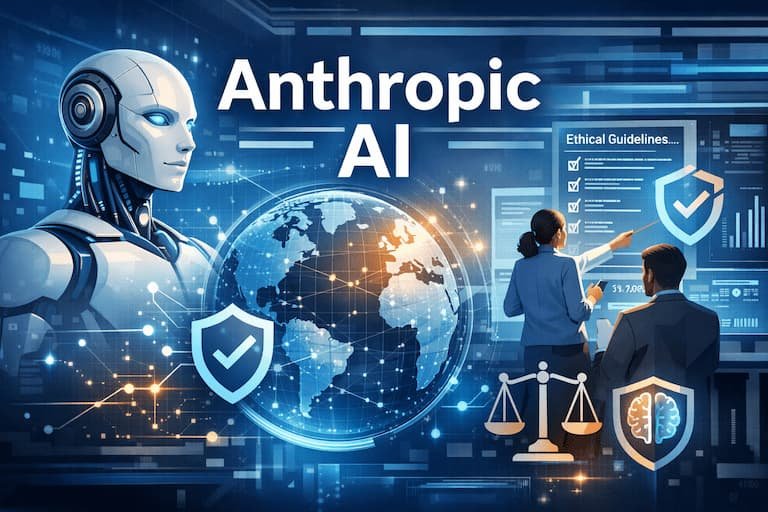
When You Ask a Question and Hope the Answer Is Actually Helpful
Think about the last time you searched for an answer online or asked an AI tool for help. Maybe you wanted to understand a concept, write an email, or solve a small problem. What you really wanted was not just an answer, but an answer that felt safe, sensible, and aligned with human values—not confusing, misleading, or harmful.
This quiet expectation is exactly where Anthropic AI enters the picture. Anthropic AI is not about louder promises or flashy marketing. Instead, it focuses on a deeper question many people don’t ask out loud: How do we make artificial intelligence helpful without letting it become harmful or unreliable?
This article explains Anthropic AI from the ground up, assuming you have no prior knowledge of artificial intelligence at all.
Understanding the Bigger Context: Why AI Needs Guardrails
Artificial Intelligence systems are now used in education, software development, research, customer support, and even healthcare assistance. These systems can write text, analyze data, and respond like humans. But with this power comes a serious challenge.
AI models learn from massive amounts of data created by humans. That data can include:
- Biases
- Inaccurate information
- Harmful language
- Conflicting values
Without careful design, an AI system may unintentionally produce unsafe, misleading, or unethical outputs. This is not a theoretical concern—it has happened before.
Anthropic AI was created to directly address this problem.
What Anthropic AI Is Really About (In Simple Terms)
Anthropic AI is a technology company that builds advanced AI systems with a strong focus on safety, reliability, and alignment with human values.
Instead of asking only:
- How powerful can AI become?
Anthropic also asks:
- How do we keep AI understandable, controllable, and beneficial to society?
This philosophy shapes everything they build.
The Core Idea Behind Anthropic AI: “Helpful, Honest, and Harmless”
Anthropic AI often describes its goal using three simple principles:
- Helpful – The AI should genuinely assist users.
- Honest – The AI should avoid making things up or presenting false confidence.
- Harmless – The AI should reduce the risk of causing harm, whether intentional or accidental.
These principles are not slogans. They are built into how the AI is trained and evaluated.
Claude: Anthropic’s AI Assistant Explained Simply
Anthropic’s best-known product is an AI assistant called Claude. You can think of Claude as a conversational AI designed to:
- Answer questions clearly
- Explain complex topics step by step
- Help with writing, research, and learning
- Avoid unsafe or misleading responses
Claude is used by students, professionals, researchers, and companies who want AI support without aggressive or risky behavior.
What Makes Anthropic AI Different from Other AI Companies
Many AI companies focus heavily on performance benchmarks—speed, size, or competitive rankings. Anthropic AI does something slightly different.
1. Safety-First Training
Anthropic invests deeply in research that studies how AI systems behave, fail, and improve under real-world conditions.
2. Constitutional AI (Beginner-Friendly Explanation)
One of Anthropic’s major innovations is something called Constitutional AI.
In simple terms:
- The AI is trained using a set of written principles (a “constitution”)
- These principles guide how the AI should respond
- Human values are embedded directly into the training process
Instead of relying only on constant human correction, the AI learns to self-regulate based on these guidelines.
Why Anthropic AI Matters in Education
For students and educators, AI tools can be extremely useful—but also risky if they provide incorrect or shallow answers.
Anthropic AI aims to support learning by:
- Encouraging clear explanations
- Avoiding overconfident misinformation
- Supporting critical thinking instead of shortcuts
This makes it more suitable for educational environments where trust and accuracy matter.
Real-World Use Cases of Anthropic AI
Anthropic AI systems are used in practical, everyday scenarios such as:
- Education: Explaining concepts, summarizing material, tutoring support
- Technology: Assisting developers with code understanding
- Research: Helping analyze and organize large amounts of information
- Business Communication: Drafting clear, professional content
The emphasis is always on reliability rather than dramatic output.
Ethical AI: Why This Approach Is Important Long-Term
As AI becomes more integrated into daily life, small design choices can have large consequences. An AI that confidently gives wrong advice can cause real harm. An AI that mirrors human bias can amplify social problems.
Anthropic AI’s research-driven approach helps:
- Reduce unintended consequences
- Improve transparency in AI behavior
- Build public trust in AI systems
This is especially important as governments, schools, and organizations begin to rely more on AI-powered tools.
Practical Insights: What Users Should Expect
If you interact with AI systems influenced by Anthropic’s philosophy, you may notice:
- More cautious responses when uncertainty exists
- Clear explanations instead of rushed answers
- Refusal to engage in harmful or misleading tasks
While this may sometimes feel slower or more restrained, it reflects a deliberate design choice focused on long-term benefit.
The Broader Impact on Emerging AI Trends
Anthropic AI represents a growing trend in the technology world: responsible innovation. Instead of moving fast and fixing problems later, this approach emphasizes careful progress.
This trend is influencing:
- AI governance discussions
- Academic research
- Industry standards for AI deployment
In the long run, such models may shape how society defines “good AI.”
A Thoughtful Way Forward
Artificial intelligence is no longer a distant concept—it is part of everyday life. As these systems grow more capable, the question is not whether AI will exist, but how it will behave.
Anthropic AI shows that it is possible to build powerful technology without ignoring responsibility. By prioritizing safety, honesty, and human values, it offers a calmer, more thoughtful vision of AI’s future.
For readers new to this space, understanding Anthropic AI is a useful first step in understanding where artificial intelligence may be heading—and why the way we build it matters just as much as what it can do.
Related Article:

One thought on “Anthropic AI Explained: Safe AI, Claude, and Ethical Innovation”