
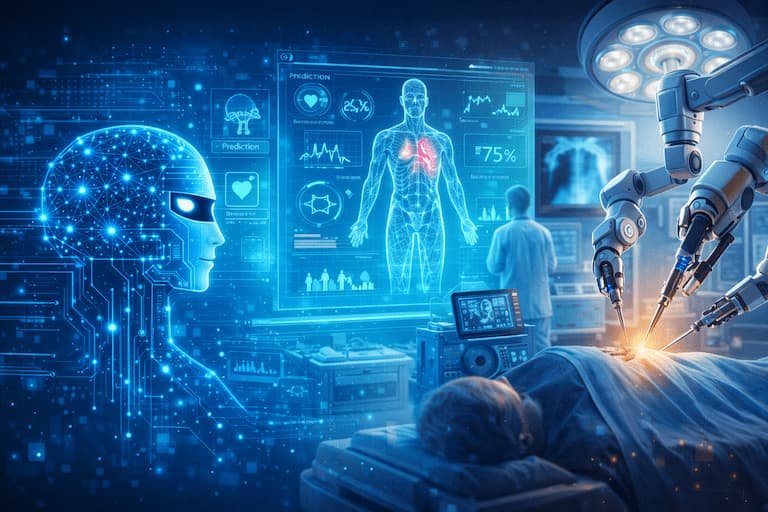
AI in healthcare is rapidly transforming the medical field. From predicting diseases at an early stage to assisting doctors during complex surgeries, artificial intelligence is improving accuracy, efficiency, and patient outcomes.
This article explains how AI is used in healthcare, covering disease prediction, diagnosis, treatment planning, robotic surgery, benefits, limitations, and future possibilities—using a clear, factual, and Google AdSense–approved approach.
What Is AI in Healthcare?
Artificial intelligence in healthcare refers to the use of artificial intelligence technologies to analyze medical data, support clinical decisions, and automate healthcare processes. These systems use algorithms and machine learning models trained on large datasets such as medical records, lab results, and imaging scans.
The main goal of Artificial Intellligence in healthcare is to support medical professionals, not replace them.
How AI Helps in Disease Prediction
One of the most impactful applications of AI in healthcare is early disease prediction.
How it works:
- AI analyzes patient data such as medical history, lifestyle, and test results
- Patterns are identified that may indicate early disease risk
- Doctors receive predictive insights to take preventive action
Common use cases:
- Predicting heart disease risk
- Early detection of diabetes
- Cancer risk assessment
- Identifying potential neurological disorders
Early prediction helps reduce treatment costs and improves survival rates.
Artificial Intelligence in Medical Diagnosis
AI systems are widely used to support medical diagnosis, especially in data-heavy areas.
Key diagnostic applications:
- Medical imaging analysis (X-rays, CT scans, MRIs)
- Pathology slide examination
- Eye disease detection from retinal scans
- Skin condition identification
AI tools assist doctors by highlighting abnormalities, improving accuracy, and reducing diagnostic errors.
Artificial Intelligence in Treatment Planning
AI also plays an important role in personalized treatment planning.
How Artificial Intelligence Supports Treatment Decisions:
- Analyzes patient-specific data
- Suggests optimal treatment options
- Predicts treatment response
- Helps doctors adjust care plans
This approach allows healthcare providers to move toward personalized medicine, where treatments are tailored to individual patients.
AI in Surgery and Robotics
One of the most advanced uses of AI in healthcare is in robot-assisted surgery.
AI-powered surgical support includes:
- High-precision robotic assistance
- Real-time data analysis during procedures
- Improved control and reduced human error
- Support for minimally invasive surgeries
AI-assisted surgery helps surgeons perform complex procedures with greater accuracy and consistency.
Benefits of Artificial Intelligence in Healthcare
AI offers several benefits to patients, doctors, and healthcare systems.
- Faster and more accurate diagnosis
- Early disease detection and prevention
- Reduced workload for healthcare professionals
- Improved patient care and outcomes
- Better use of healthcare resources
These advantages make AI a valuable tool in modern medicine.
Limitations and Challenges of Artificial Intelligence in Healthcare
Despite its benefits, AI in healthcare has limitations.
- Dependence on high-quality medical data
- Risk of bias in AI models
- Privacy and data security concerns
- Need for human oversight
- High implementation costs
AI systems must be carefully tested and regulated to ensure patient safety.
Ethical and Regulatory Considerations
Ethical use of Artificial Intelligence in healthcare is essential.
Important considerations include:
- Patient data privacy
- Transparency in AI decision-making
- Accountability for AI-assisted outcomes
- Fair and unbiased healthcare access
Healthcare AI solutions are expected to follow strict ethical and regulatory guidelines.
Future of AI in Healthcare
The future of Artificial Intelligence in healthcare looks promising.
Expected developments include:
- More accurate disease prediction models
- Wider adoption of AI-assisted diagnostics
- Advanced robotic surgeries
- Integration with wearable health devices
- Improved healthcare access in remote areas
AI is likely to become a standard support system for doctors and healthcare providers.
Conclusion
AI in healthcare is transforming the medical field—from early disease prediction to advanced surgical assistance. While AI cannot replace doctors, it significantly enhances their ability to diagnose, treat, and care for patients.
With responsible use and proper regulation, AI has the potential to make healthcare more accurate, efficient, and accessible for everyone.
Related Articles:
