
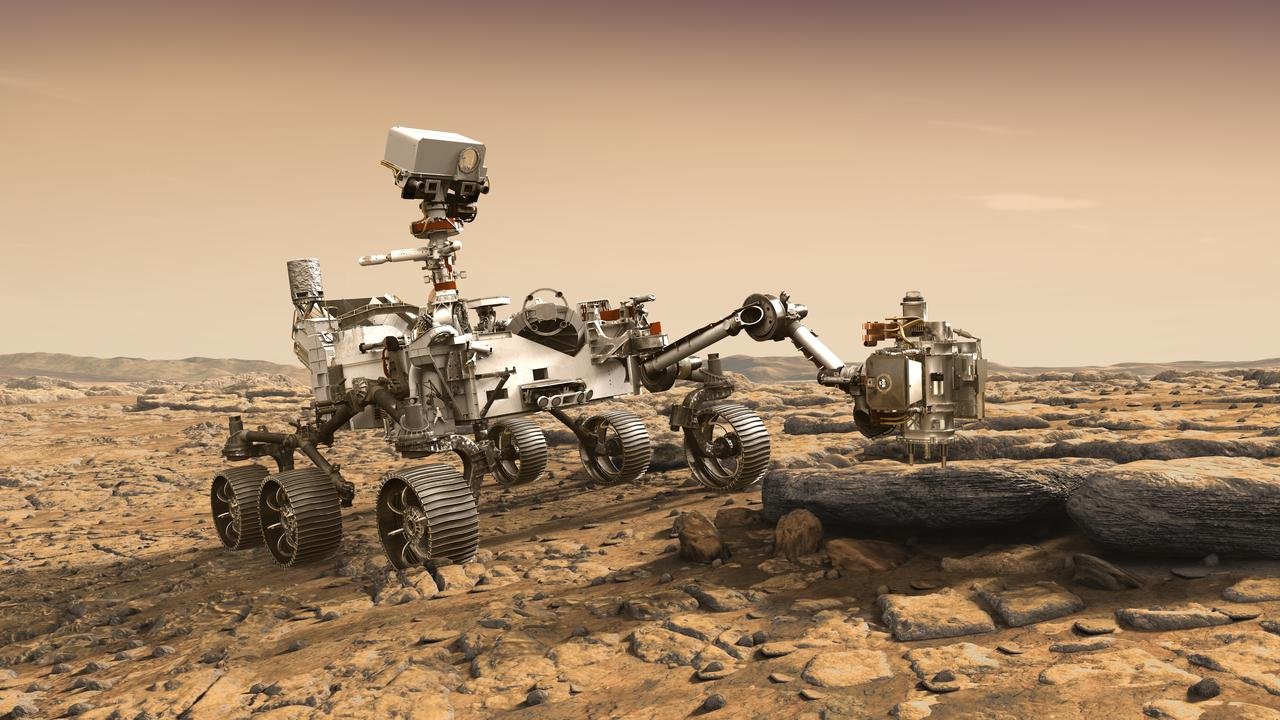
Imagine standing on Mars four billion years ago. Rivers are flowing. Lakes are forming. And somewhere, perhaps, life is just getting started. Sounds like science fiction? Think again. Currently, NASA’s Perseverance rover is transforming the course of history, and its latest findings are truly astounding.
Using ground-penetrating radar, NASA’s Perseverance rover has detected underground remains of an ancient river delta on Mars—making this one of the oldest pieces of evidence yet obtained showing how water once flowed freely across the Red Planet. If you ever wondered whether Mars was once alive with rivers and lakes, this discovery is your answer.
What Did Perseverance Actually Find?
Researchers said the six-wheeled rover revealed geological features up to 115 feet (35 meters) underground while traversing 3.8 miles (6.1 km) of terrain inside Jezero Crater—a region in Mars’s northern hemisphere believed to have once been flooded with water.
What kind of features? Specifically:
- Layered sediments—stacked rock layers that form when water deposits material over a long period of time
- Eroded surfaces—surfaces worn away by flowing water, just like riverbeds on Earth
- Delta-shaped formations—a fan-shaped deposit that forms exactly where a river meets a lake
They estimated that the now-buried delta dates to about 3.7 to 4.2 billion years ago. Mars, like Earth, formed roughly 4.5 billion years ago, meaning this delta existed relatively early in its history.
Think about that. When dinosaurs were the most advanced life on Earth, this Mars delta was already ancient history—by over 3 billion years.
💡 Did You Know? The delta found underground by Perseverance is older than the visible Western Delta on Mars’s surface, which dates to around 3.5 to 3.7 billion years ago. This makes the newly discovered formation one of the earliest known water structures on the planet.
How Does RIMFAX Work? The Tech Behind the Discovery
Here’s where things get really cool from a technology perspective.
Perseverance didn’t just stumble upon this buried delta by digging. It used a cutting-edge instrument called RIMFAX—short for Radar Imager for Mars‘ subsurface experiment.
Think of RIMFAX like a medical ultrasound, but for the ground under Mars. The rover’s RIMFAX instrument sends radar pulses downward and records pulses bouncing back off underground features, allowing a three-dimensional mapping of the subsurface.
It’s the same basic principle as ground-penetrating radar (GPR) used here on Earth—archaeologists use it to find buried ruins, and utility workers use it to locate underground pipes. Now NASA is using it to find ancient rivers on another planet.
The new findings were based on RIMFAX’s deepest data collected to date, obtained from September 2023 to February 2024 over a span of 250 Martian days.
That’s 250 Martian days—nearly an entire Martian year—of continuous underground scanning. The level of precision here is extraordinary.
💡 Did You Know? One Martian day (called a “sol”) is about 24 hours and 37 minutes—just slightly longer than an Earth day. So 250 Martian days is approximately 256 Earth days.
Key tech specs of RIMFAX:
| Feature | Detail |
|---|---|
| Instrument Type | Ground-Penetrating Radar (GPR) |
| Detection Depth | Up to 35 meters underground |
| Data Collection Period | Sept 2023 – Feb 2024 |
| Terrain Covered | 6.1 km inside Jezero Crater |
| Output | 3D subsurface geological map |
As UCLA planetary scientist and study co-author David Paige noted, this further confirms that ground-penetrating radar is an extremely valuable new tool for studying planetary geology. The results were published in the journal Science Advances.
Jezero Crater—Mars’s Ancient Lake Basin
You’ve heard the name Jezero Crater a few times already. But what exactly is it, and why did NASA choose this spot?
Jezero Crater is an area in the Martian northern hemisphere believed to have been flooded with water and home to an ancient lake basin long ago. Scientists believe river channels spilled over the crater wall and created a lake.
From a geological standpoint, Jezero Crater is to Mars what the Amazon Basin is to Earth — a region defined by water. It’s roughly 49 km (30 miles) wide, and scientists have long suspected it was once a vibrant, water-filled environment.
Perseverance has been exploring Jezero Crater since 2021. Over these years, it has been methodically scanning, sampling, and sending back data that paints a rich picture of a planet that was once nothing like the frozen desert we see today.
The visible Western Delta on the surface of Jezero has already fascinated scientists for years. But this new underground delta is older, deeper, and potentially more significant—because it pushes the timeline of Martian water back even further.
What Is a River Delta, and Why Does It Matter?
If you’ve ever looked at Google Maps and zoomed into where the Nile or Ganges meets the ocean, you’ve seen a river delta—that classic fan-shaped spread of land and waterways. The same kind of formation exists buried beneath Jezero Crater on Mars.
Perseverance identified layered sediments and eroded surfaces indicative of a delta environment, a large-scale fan-shaped deposit of sediment formed at the location where a river enters a larger body of water like a lake.
Why does this matter so much? This is due to the fact that river deltas are considered by scientists to be among the most optimal locations for searching for indications of ancient life. Here on Earth, river deltas are biological hotspots. The Nile Delta, the Mississippi Delta—all of them are extraordinarily rich in organic matter and microbial life.
On Earth, river deltas are places that concentrate sediments and create niches favorable to microbial life.
If ancient microbial life ever existed on Mars, a delta environment—with its layered sediments, moisture, and chemical diversity—is precisely the kind of place it would have thrived. And crucially, it’s precisely the kind of place where biosignatures (chemical or physical evidence of past life) could be preserved for billions of years.
Could Ancient Mars Have Supported Life?
This is the question everyone really wants answered.
The mounting evidence of Mars’ wet past is particularly interesting because water is considered crucial for the possibility of past life on the planet. Mars, now cold and desolate, long ago possessed a thicker atmosphere and warmer climate, allowing for liquid water on its surface.
The scientific logic goes like this:
- Water is a basic requirement for life as we know it
- Mars had liquid water on its surface billions of years ago
- River deltas form where water flows into lakes—perfect habitats
- Sediment layers preserve organic material and biosignatures
- Therefore, Mars could have hosted microbial life, and the evidence might still be buried
And here’s the stunning part—it’s not just theoretical anymore. Scientists in 2025 announced that a rock sample collected by Perseverance in Jezero Crater showed signs that could indicate ancient microbial life, although the minerals in the sample can also form without any biological activity.
So we don’t have confirmed life yet—but we’re closer than we’ve ever been.
Analysis of ancient dunes in Gale Crater indicates that underground water persisted on Mars after surface lakes and rivers vanished. This subsurface water altered the dunes, depositing minerals like gypsum that can preserve organic material. The findings suggest Mars may have remained habitable for life longer than previously estimated, with protected underground environments offering potential sites for biosignature searches.
In other words, even after Mars lost its surface water, life could potentially have survived underground for millions of years longer.
💡 Did You Know? Gypsum—the same mineral found in drywall in your home—has been detected in Martian soil. On Earth, gypsum forms in water. Its presence on Mars is strong indirect evidence of past liquid water environments.
NASA’s Oldest Evidence of Water on Mars—Why This Discovery is Different
You might be wondering: haven’t scientists found water evidence on Mars before? Yes—but this discovery stands apart for several important reasons.
What makes this find uniquely significant:
- Age: At 3.7 to 4.2 billion years old, this buried delta is among the oldest water-related geological structures ever found on Mars
- Depth: The features were detected up to 35 meters below the surface — far deeper than surface-level observations
- Technology: RIMFAX’s 3D subsurface mapping gives researchers a complete cross-sectional view, not just surface-level clues
- Location confirmation: It directly validates what scientists had long theorized about Jezero Crater being a lake basin
- Pre-dates known features: The researchers said this delta predated a similar nearby surface feature called the Western Delta that dates to about 3.5 to 3.7 billion years ago—meaning Mars’s water story goes back even further
Lead researcher Emily Cardarelli, a UCLA planetary scientist and member of the Perseverance science team, stated that Jezero Crater hosted an ancient water-rich environment capable of biosignature preservation that existed even before the formation of the Western Delta.
This isn’t just another “trace of water” story. This is a complete buried river delta with layered sediments—the geological equivalent of finding an ancient city under a modern one.
[Link: Complete Timeline of Mars Exploration Missions by NASA]
What Happens Next? Mars Sample Return Mission
So we have underground evidence. We have potential biosignatures. What’s the next step?
The answer is the Mars Sample Return (MSR) mission—a joint project between NASA and the European Space Agency (ESA). Perseverance has already been collecting rock and soil samples in sealed tubes, carefully depositing them at designated locations on Mars.
The plan is to eventually launch a retrieval mission that brings those samples back to Earth, where scientists can analyze them with far more powerful tools than any rover can carry.
Why does returning samples matter?
- Lab instruments on Earth are millions of times more sensitive than rover instruments
- Scientists can perform tests that are impossible to do remotely
- Samples can be studied by researchers worldwide for decades
- It’s the only way to definitively confirm or rule out ancient life
The discovery of this buried ancient delta makes the MSR mission even more critically important. The older the water evidence, the more likely that any preserved biosignatures date back to Mars’s most potentially habitable period.
FAQ Section
Q1: What exactly did NASA’s Perseverance rover find on Mars? Perseverance used its RIMFAX ground-penetrating radar instrument to detect a buried ancient river delta inside Jezero Crater, located up to 35 meters underground. The delta contains layered sediments and eroded surfaces, indicating that a river once flowed into a lake in this location approximately 3.7 to 4.2 billion years ago.
Q2: How old is the water evidence found on Mars? The newly discovered buried delta is estimated to be between 3.7 and 4.2 billion years old, making it one of the oldest pieces of evidence for flowing water ever found on Mars. For context, Mars itself formed about 4.5 billion years ago.
Q3: Does this finding mean there was life on Mars? Not confirmed yet. However, this discovery significantly strengthens the scientific case that Mars once had conditions suitable for microbial life. River deltas on Earth are known to be excellent environments for life, and scientists have also found a potential biosignature in a rock sample from Jezero Crater, though it hasn’t been conclusively attributed to biology.
Q4: What is RIMFAX, and how does it work? RIMFAX (Radar Imager for Mars’ subsurface experiment) is a ground-penetrating radar instrument on the Perseverance rover. It sends radar pulses into the ground and records how they bounce back from subsurface features, creating a 3D map of what lies underground—similar to how ultrasound imaging works in medicine.
Q5: What happens to the rock samples? Perseverance has collected? Perseverance has been sealing rock and soil samples in tubes and leaving them on the Martian surface. NASA and ESA are planning a Mars A sample return mission that would retrieve these samples and bring them back to Earth for detailed laboratory analysis—potentially the most important scientific mission in history.
8. Conclusion
Mars was never the dead, barren planet we once assumed. Four billion years ago, rivers carved their way across its surface, deltas formed at the edges of ancient lakes, and the conditions for life—at least microbial life—were very much present.
The NASA rover’s detection of some of the oldest evidence of water flowing on Mars is more than a scientific milestone. It’s a reminder that our solar system has secrets we’re only beginning to uncover. Every radar pulse from RIMFAX and every rock sample sealed by Perseverance brings us one step closer to answering the biggest question humanity has ever asked: Are we alone?
The story of Mars is still being written—and the most exciting chapters may be yet to come.
Found this article fascinating? Share it with someone who loves space, drop a comment with your thoughts below, and subscribe to our newsletter for the latest space science updates delivered straight to your inbox. The universe isn’t going to wait—and neither should you.

Thanks , I’ve recently been searching for information approximately this topic for
a long time and yours is the greatest I’ve discovered till now.
But, what concerning the bottom line? Are you positive concerning the supply?