
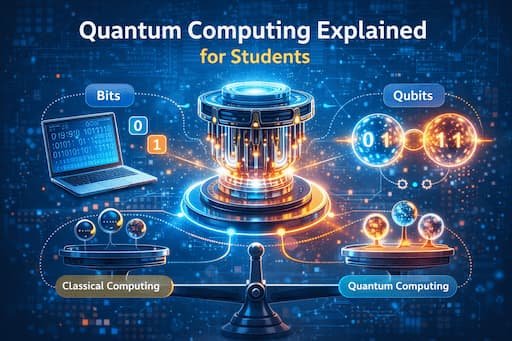
Quantum computing is one of the most exciting topics in modern science and technology. While traditional computers are powerful, quantum computing works in a very different and advanced way.
This article explains what quantum computing is in simple language, with straightforward examples, so that students can understand it without any technical difficulty.
What Is Quantum Computing?
A quantum computer is a type of computation that uses the principles of quantum physics to process information.
Unlike normal computers that use bits (0 or 1), quantum computers use qubits.
A qubit can be 0, 1, or both at the same time, which makes quantum computers very powerful.
In simple words:
quantum computer allows computers to solve very complex problems much faster than normal computers.
How Is Quantum Computer Different from Classical Computing?
| Classical Computer | Quantum Computer |
|---|---|
| Uses bits (0 or 1) | Uses qubits |
| Works step by step | Works on many possibilities at once |
| Limited speed for complex problems | Extremely fast for certain tasks |
| Used in everyday devices | Used mainly in research and science |
Because of these differences, quantum computers are not meant to replace normal computers but to solve special types of problems.
What Is a Qubit?
A qubit is the basic unit of quantum based system.
Key properties of a qubit:
- It can exist in multiple states at the same time
- It can be connected with other qubits (entanglement)
- It can process large amounts of data simultaneously
These properties make quantum computers much more powerful than traditional systems.
Simple Example to Understand next-generation computing
Imagine a maze with many paths.
- A classical computer checks one path at a time
- A quantum computer checks all paths at the same time
This is why quantum-based computing is so fast for complex problems.
Where is next-generation computing used?
Quantum-based systems are still developing, but they have many important applications.
Major uses include:
- Medicine: Drug discovery and disease research
- Science: Studying complex chemical reactions
- Cybersecurity: Developing new encryption methods
- Artificial Intelligence: Improving machine learning models
- Climate Research: Weather and climate simulations
These areas require massive calculations that normal computers struggle to handle.
Benefits of Quantum Computing
Quantum-based systems offer several advantages.
- Solves complex problems faster
- Handles large data sets efficiently
- Improves scientific research
- Enables advanced simulations
These benefits make quantum-based computing a key future technology.
Limitations of this advanced computing technology
Despite its potential, quantum computing has limitations.
- Very expensive technology
- Requires extremely controlled environments
- Difficult to build and maintain
- Still in the research stage
Because of these challenges, quantum computers are not yet widely available.
Is this advanced computing technology dangerous?
The quantum computer itself is not dangerous.
However, it may challenge current data security systems in the future.
This is why researchers are also developing quantum-safe security methods.
Future of Quantum Computing
The future of quantum computing looks promising.
Expected developments include:
- More stable quantum computers
- Better error correction
- Practical applications in medicine and science
- Wider access through cloud platforms
In the coming years, quantum computing may become an important tool for solving global problems.
Conclusion
Quantum computing is a powerful and advanced form of computing based on quantum physics. Although it is still developing, it has the potential to transform science, medicine, technology, and research.
For students, understanding the basics of quantum computing is important because it represents the future of computing and innovation.
For a basic scientific overview of quantum computing, students can also refer to publicly available educational resources. https://en.wikipedia.org/wiki/Quantum_computing
Related Articles:
