
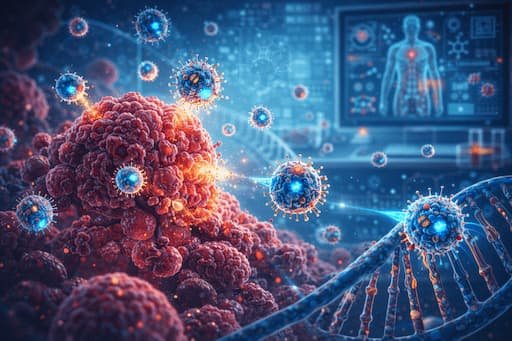
Cancer treatment has improved a lot in recent years, and nanotechnology is one of the key reasons behind this progress. Scientists are now using extremely small particles to detect cancer early, deliver medicines directly to cancer cells, and reduce side effects.
This article explains how nanotechnology in cancer treatment works in a simple, organized, and easy-to-understand way for students.
What Is Nanotechnology?
Nanotechnology is a branch of science that works with very tiny materials called nanoparticles. These particles are so small that they are measured in nanometers, which are much smaller than human cells.
Because of their tiny size, nanoparticles can move easily inside the human body and interact with cells at a very precise level.
Why Is Nanotechnology Important in Cancer Treatment?
Traditional cancer treatments like chemotherapy and radiation affect both cancer cells and healthy cells, which causes side effects.
Nanotechnology helps solve this problem by:
- Targeting only cancer cells
- Delivering drugs more accurately
- Reducing damage to healthy tissues
This makes cancer treatment safer and more effective.
How Nanotechnology Detects Cancer Early
Early detection is crucial for successful cancer treatment.
Role of nanotechnology in detection:
- Nanoparticles can attach to cancer cells
- They help doctors identify tumors at an early stage
- Imaging becomes more accurate
Early detection increases the chances of successful treatment.
How Nanotechnology Delivers Cancer Drugs
One of the biggest uses of nanotechnology in cancer treatment is targeted drug delivery.
How it works:
- Cancer-fighting drugs are placed inside nanoparticles
- These nanoparticles travel through the bloodstream
- They attach specifically to cancer cells
- The drug is released directly at the tumor site
This method reduces side effects and improves treatment results.
Nanotechnology in Chemotherapy
Traditional chemotherapy affects the whole body.
Nanotechnology-based chemotherapy focuses only on cancer cells.
Benefits include:
- Lower drug dosage
- Fewer side effects
- Better patient comfort
- Higher treatment efficiency
This approach improves the quality of life for patients.
Nanotechnology and Cancer Surgery
Nanotechnology also helps surgeons during cancer operations.
Surgical benefits:
- Nanoparticles highlight cancer cells
- Surgeons can see tumor boundaries clearly
- More accurate removal of cancer tissue
This reduces the risk of leaving behind cancer cells.
Advantages of Nanotechnology in Cancer Treatment
Nanotechnology offers many advantages over traditional methods.
- Precise targeting of cancer cells
- Reduced harm to healthy cells
- Early detection support
- Improved drug effectiveness
- Better recovery outcomes
These benefits make nanotechnology a promising tool in modern medicine.
Limitations and Challenges
Despite its potential, nanotechnology has some challenges.
- High research and development cost
- Limited availability in some regions
- Long-term safety studies still ongoing
- Requires advanced medical infrastructure
Scientists continue to research ways to overcome these challenges.
Future of Nanotechnology in Cancer Treatment
The future looks promising for nanotechnology-based cancer treatment.
Expected developments include:
- Smarter nanoparticles
- More personalized cancer therapies
- Wider clinical use
- Improved survival rates
As research advances, nanotechnology may become a standard part of cancer care.
Conclusion
Nanotechnology in cancer treatment is making it possible to fight cancer more effectively and safely. By improving early detection, targeted drug delivery, and surgical accuracy, nanotechnology is transforming how cancer is treated.
With continued research and responsible use, nanotechnology can play a major role in saving lives and improving healthcare outcomes.
Related Articles:
