
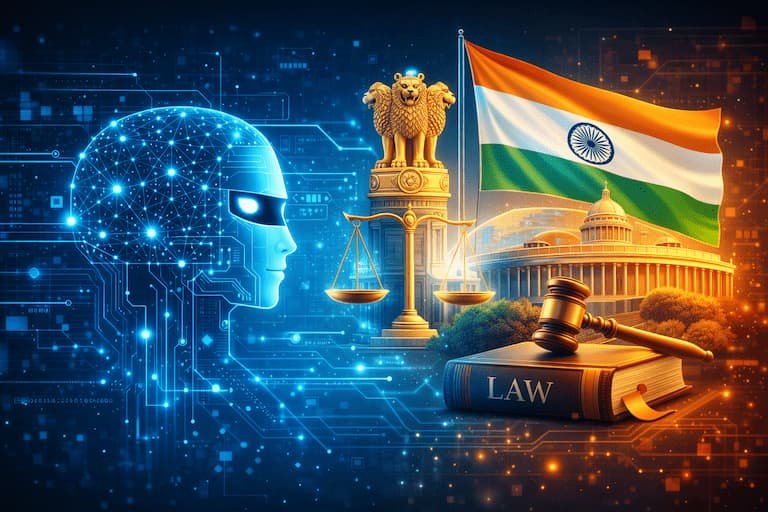
Artificial Intelligence (AI) is rapidly transforming India’s digital landscape. From healthcare and education to finance, governance, and startups, AI technologies are being adopted at an unprecedented scale. As AI usage grows, an important question arises: What is the future of AI law and regulation in India?
This article provides a clear, factual, and AdSense-approved overview of India’s current AI regulatory position, government approach, challenges, and the likely future direction of AI governance.
Why AI Regulation Is Important in India
AI systems can improve efficiency and innovation, but they also raise concerns related to safety, privacy, and accountability. Regulation is needed to ensure that AI is developed and used responsibly.
Key reasons for AI regulation include:
- Protection of personal data and privacy
- Prevention of algorithmic bias and discrimination
- Transparency in automated decision-making
- Reducing misuse such as deepfakes and misinformation
The goal of AI regulation is not to restrict innovation, but to create a framework that encourages responsible and ethical use.
Current Status of AI Laws in India
At present, India does not have a dedicated standalone AI law. Instead, AI systems are governed through existing laws and policy frameworks that indirectly apply to artificial intelligence.
Important frameworks include:
- The Information Technology Act, 2000
- The Digital Personal Data Protection (DPDP) Act
- Policy initiatives by NITI Aayog on Responsible AI
- India’s National Strategy for Artificial Intelligence
These instruments form the foundation of India’s current AI governance model.
Government Approach to AI Regulation
India’s approach to AI regulation is generally considered balanced and innovation-friendly. The government has emphasized the importance of promoting technology growth while addressing potential risks.
Key aspects of this approach include:
- Avoiding over-regulation that could slow innovation
- Encouraging self-regulation and ethical guidelines
- Focusing on high-risk AI applications rather than blanket restrictions
- Supporting startups and research ecosystems
Unlike some regions that favor strict AI bans, India is leaning toward a risk-based regulatory model.
Challenges in Regulating AI in India
Creating effective AI regulations is complex, especially in a fast-developing digital economy like India.
Major challenges include:
- Rapid evolution of AI technologies
- Limited regulatory expertise in advanced AI systems
- Aligning domestic rules with global AI standards
- Ensuring compliance without harming innovation
These challenges explain why India is moving cautiously and incrementally.
Future Roadmap for AI Law and Regulation in India
Experts suggest that India’s AI regulatory framework will evolve gradually rather than through sudden, strict legislation.
Expected developments may include:
- Sector-specific AI guidelines for healthcare, finance, and education
- Risk classification of AI systems
- Rules for algorithm transparency and audits
- Stronger enforcement of data protection standards
- National ethical AI principles
Over time, these elements could form a comprehensive AI governance framework tailored to India’s needs.
Impact on Startups and Businesses
AI regulation will have both positive and challenging effects on Indian companies.
Potential benefits:
- Increased trust among users and investors
- Better global market access
- Clear compliance standards
Possible concerns:
- Higher compliance costs
- Additional documentation requirements
- Initial uncertainty during policy transitions
To address this, the government has emphasized industry consultation and stakeholder participation.
India in the Global AI Regulation Landscape
Globally, countries are adopting different approaches to AI governance.
- European Union: Strict, risk-based AI regulation
- United States: Flexible and industry-driven approach
- India: Balanced model focused on innovation and inclusion
India’s strategy reflects its socio-economic priorities and digital growth goals.
Will India Ban AI Technologies?
There is no indication that India plans to ban AI technologies. The focus remains on:
- Preventing harmful or unethical use
- Protecting citizen rights
- Encouraging safe and responsible AI adoption
Regulation in India is expected to support AI growth rather than restrict it.
Conclusion
The future of AI law and regulation in India will be shaped by the need to balance innovation with responsibility. While India currently relies on existing laws and policy frameworks, a more structured AI governance model is likely to emerge over time.
With a gradual, risk-based, and consultative approach, India aims to build an AI ecosystem that is innovative, ethical, and globally competitive.
Related Articles:
