
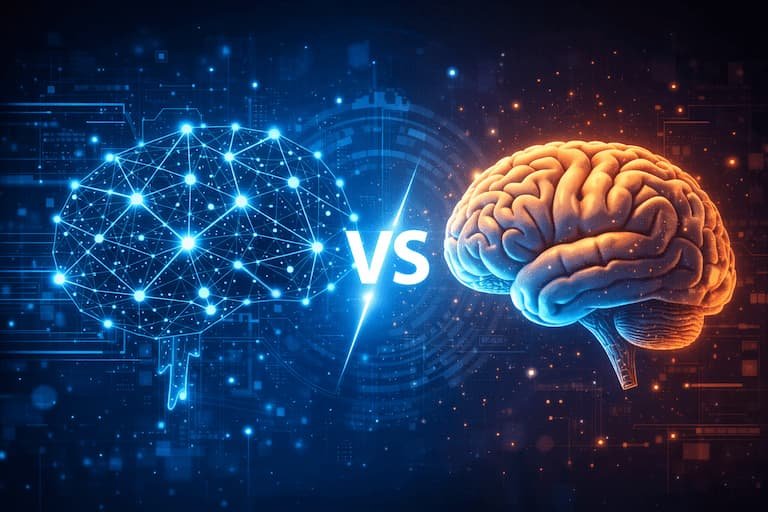
AI vs. human intelligence is one of the most discussed topics in modern science and technology. As artificial intelligence systems become more capable, many people wonder how machine intelligence compares with the human mind and what this means for the future of work, education, and society.
This article provides a neutral, factual, and beginner-friendly comparison of AI and human intelligence, explaining how they work, where each excels, their limitations, and how they are likely to coexist in the future.
What Is Artificial Intelligence?
Artificial Intelligence (AI) refers to computer systems designed to perform tasks that typically require human intelligence. These tasks include learning from data, recognizing patterns, understanding language, and making decisions based on rules or probabilities.
AI systems operate using algorithms, data, and computational models. They do not possess consciousness or emotions; instead, they process information mathematically to produce results.
What Is Human Intelligence?
Human intelligence is the natural cognitive ability of humans to think, reason, learn, feel emotions, and adapt to new situations. It includes creativity, moral judgment, empathy, and common sense developed through experience and social interaction.
Unlike machines, human intelligence is shaped by biology, culture, environment, and personal experiences.
How AI Intelligence Works
AI intelligence is based on:
- Data-driven learning
- Statistical models and algorithms
- Pattern recognition
- Continuous optimization
Modern AI systems learn from large datasets and improve performance over time. However, their understanding is limited to the data and rules they are trained on.
How Human Intelligence Works
Human intelligence works through:
- Biological neural networks (the brain)
- Emotions and intuition
- Conscious reasoning
- Social and ethical awareness
Humans can understand context deeply, learn from limited examples, and apply knowledge creatively across different situations.
AI vs Human Intelligence: Key Differences
| Aspect | Artificial Intelligence | Human Intelligence |
|---|---|---|
| Origin | Machine-created | Biological |
| Learning method | Data and algorithms | Experience and reasoning |
| Creativity | Limited and pattern-based | Original and imaginative |
| Emotions | None | Present |
| Adaptability | Task-specific | Highly flexible |
| Ethics and values | Programmed rules | Moral judgment |
This comparison shows that AI and human intelligence are fundamentally different in nature and capability.
Strengths of Artificial Intelligence
AI systems offer several advantages in specific areas.
- High-speed data processing
- Consistent performance without fatigue
- Ability to handle large-scale repetitive tasks
- Useful for analysis, prediction, and automation
These strengths drive the widespread use of AI in technology, healthcare analysis, finance, and scientific research.
Strengths of Human Intelligence
Human intelligence excels in areas where machines struggle.
- Creative thinking and innovation
- Emotional understanding and empathy
- Ethical decision-making
- Contextual and common-sense reasoning
These abilities are essential in leadership, education, healthcare, and social interactions.
Limitations of Artificial Intelligence
Despite rapid progress, AI has clear limitations.
- No true understanding or consciousness
- Dependence on training data quality
- Difficulty handling unexpected situations
- Lack of moral reasoning
As a result, AI systems require human supervision and responsible use.
Limitations of Human Intelligence
Human intelligence also has constraints.
- Limited processing speed compared to machines
- Subject to bias and fatigue
- Errors due to emotions or stress
- Physical and cognitive limits
This is why technology is often used to support human decision-making.
Real-World Use Cases: AI and Humans Together
In practice, AI and human intelligence work best together, not in competition.
Examples:
- Doctors using AI tools for diagnosis support
- Engineers using AI for code suggestions
- Teachers using AI for personalized learning content
- Researchers using AI for data analysis
These collaborations improve efficiency while maintaining human judgment.
Will AI Replace Human Intelligence?
AI is unlikely to replace human intelligence entirely. While AI can automate specific tasks, it cannot replicate human creativity, emotions, and ethical reasoning.
The future points toward augmentation, where AI enhances human abilities rather than replacing them.
Future of AI and Human Intelligence
Looking ahead, the relationship between AI and human intelligence will continue to evolve.
Expected developments include:
- More human-AI collaboration tools
- AI systems focused on assistance rather than replacement
- Increased emphasis on ethical and responsible AI
- New skills centered on creativity and critical thinking
Understanding these differences will help individuals and organizations adapt effectively.
Conclusion
AI vs. human intelligence is not a battle but a comparison of two very different forms of intelligence. AI excels at speed, scale, and automation, while human intelligence leads in creativity, empathy, and ethical reasoning.
By combining the strengths of both, society can achieve better outcomes in science, education, technology, and everyday life.
For more technical research on AI and Human intelligence, you can explore reports published by leading technology research organizations. wikipedia
Related Articles:
